 info@forpeat.eu


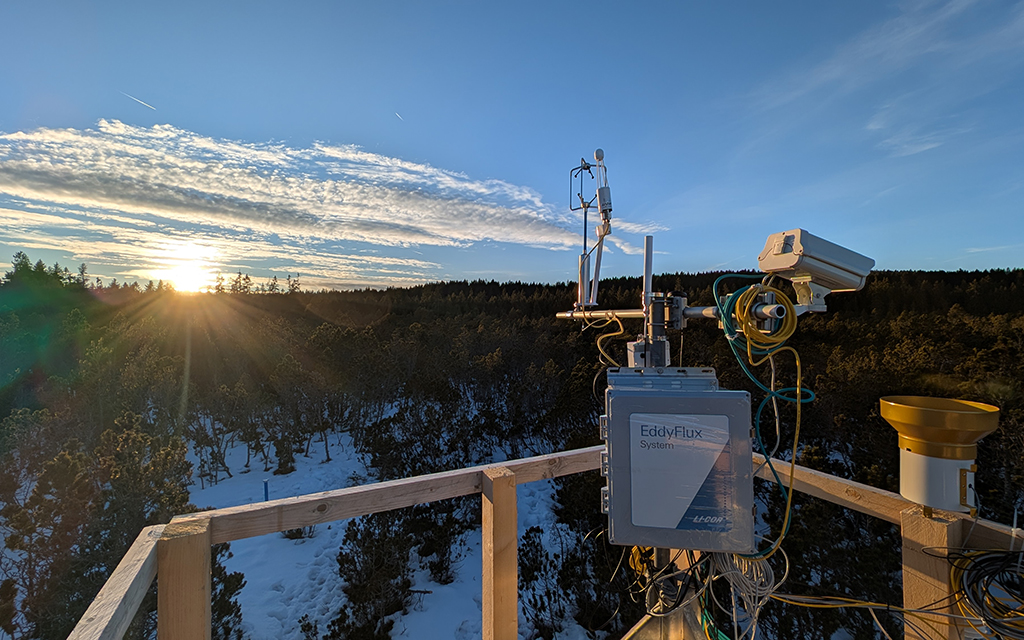
A key milestone has been reached at ForPeat’s Austrian Open Lab. The team has successfully installed an eddy covariance tower at Karlstifter Moor, enabling continuous measurement of greenhouse gas fluxes. Read more.
Peatlands play a critical role in regulating the climate by storing vast amounts of carbon. However, when drained and degraded, they can shift from carbon sinks to significant sources of greenhouse gas emissions. Restoring these ecosystems requires precise, long-term monitoring to understand how restoration measures influence carbon dynamics.
At ForPeat’s Open Lab 4, located in the Karlstifter Moor complex in Austria, restoration planning is currently underway (in course of the LIFE AmooRe project). Over the past century, drainage has lowered the water table, allowing woody vegetation to expand across the raised bog. Today, much of the area is densely forested, while only small patches of characteristic bog vegetation remain. The primary restoration objective is to rewet the peatland, restoring its natural hydrology and preventing further carbon loss.

To support this effort, the Open Lab 4 team has installed an eddy covariance flux tower, a system that continuously measures the exchange of greenhouse gases between the ecosystem and the atmosphere. This technology provides data on carbon dioxide fluxes, enabling researchers to quantify whether the peatland is acting as a carbon source or sink over time.

These measurements will be complemented by transportable trace gas analysers, water level monitoring, meteorological observations, soil sampling, and biodiversity surveys. In addition, vegetation indices, such as the Normalised Difference Vegetation Index (NDVI), which is based on satellite and in situ monitoring, will help track vegetation dynamics and ecosystem recovery. The data collected at Karlstifter Moor will provide valuable insights into how restoration measures influence carbon balance, ecosystem functioning, and long-term peatland resilience.
This work forms part of the broader ForPeat project, which has established eight Open Labs across Europe to test sustainable land management and restoration practices in peatlands. By combining field monitoring, modelling tools, and nature-based solutions, ForPeat aims to enhance carbon sequestration, improve soil health, and support biodiversity while contributing to Europe’s climate mitigation goals.
The pictures of this article have been provided by the team of the University of Natural Resources and Life Sciences Vienna.