 info@forpeat.eu


Ground beetles are among the most widely used bioindicators of environmental change. Discover why these insects play such an important role in peatland restoration and how ForPeat researchers use them to monitor ecosystem recovery across Europe.
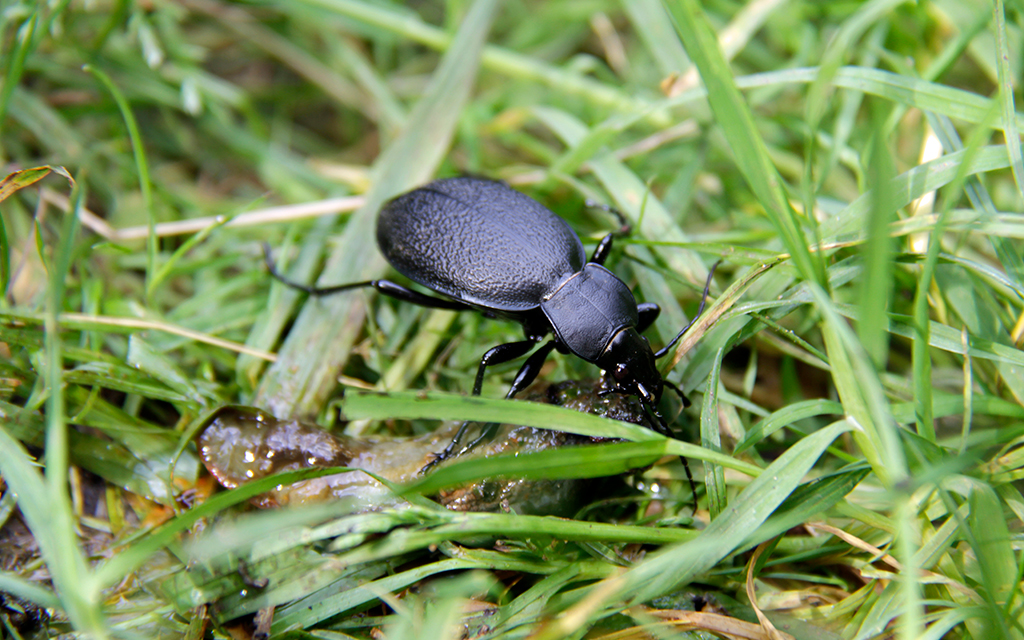
When we think about peatland restoration, our attention often goes to water levels or mosses. But some of the most valuable information about ecosystem recovery comes from organisms living in the soil.
Among them are ground beetles (family Carabidae), one of the most widely used insect groups as bioindicators of environmental change and habitat quality. These tiny animals provide scientists with important clues about the health of peatlands and whether restoration efforts are moving ecosystems in the right direction.
What is a bioindicator?
A bioindicator is a species or group of species whose presence, abundance or behaviour reflects the condition of an ecosystem. Rather than measuring environmental change directly, scientists can observe how living organisms respond to changes in their surroundings. Because different species have different ecological requirements, shifts in their populations can provide evidence of habitat degradation, pollution, or ecosystem recovery (Mcgeoch, et al., 2013).
Bioindicators are used in many different ecosystems. Lichens, for example, are highly sensitive to air pollution and are widely used to monitor air quality (Thakur, et al., 2023). Freshwater macroinvertebrates such as mayflies help assess river health (Benhadji et al., 2025), while amphibians are often considered indicators of environmental quality because their permeable skin makes them particularly vulnerable to pollution and habitat alteration (Ferreira et al., 2025).
But why study ground beetles?
Ground beetles have become one of the most widely used groups of insects in ecological monitoring. Why? Because they combine several characteristics that make them reliable indicators of environmental change.
One of their greatest strengths is their close relationship with the habitats they occupy. Most ground beetles spend their entire lives on or within the soil surface, where they are directly exposed to local environmental conditions. Changes in soil moisture, vegetation structure, temperature, or land management can quickly alter which species are able to survive in a particular area.
Ground beetles are also remarkably diverse. With more than 40,000 described species worldwide, they occur in almost every terrestrial ecosystem, from forests and peatlands to agricultural fields, grasslands and alpine environments. This diversity means that different species are associated with different habitat types and environmental conditions.
Another important advantage is that ground beetles are relatively easy to monitor. They are commonly sampled using pitfall traps, a simple and inexpensive method that allows researchers to collect beetles moving across the soil surface over extended periods.
Equally important is the extensive scientific knowledge available about this group. Ground beetles are among the best-studied insects in the world. Their taxonomy is well established, identification guides exist for many regions, and decades of ecological research have documented the habitat preferences, life histories and environmental tolerances of numerous species. This wealth of knowledge allows researchers to identify the beetles they collect, and also to interpret what those species reveal about the condition of the ecosystem (Kotze et al., 2011).
How do ground beetles reveal ecosystem recovery?
Ground beetles reveal ecosystem recovery because different species have different ecological requirements. Rather than simply counting how many beetles are present, scientists examine which species are found and how the composition of the community changes over time. Since each species is adapted to particular environmental conditions, changes in the beetle community reflect changes in the habitat itself.
In peatlands, for example, some ground beetles are closely associated with wet, undisturbed habitats, while others are more common in drained or degraded areas. As restoration raises water tables, alters vegetation and recreates peatland conditions, the beetle community responds accordingly. The gradual return of peatland specialists, together with the decline of species typical of degraded habitats, provides evidence that ecological conditions are improving and that restoration measures are moving the ecosystem towards recovery.
Ground beetles in ForPeat
Across the ForPeat Open Labs, researchers monitor multiple indicators to understand how forested peatlands respond to restoration measures. Alongside vegetation, greenhouse gas fluxes, hydrology and soil properties, ground beetles provide a valuable biological perspective on ecosystem recovery. By comparing beetle communities before and after restoration and also across different restoration approaches, scientists can better understand how biodiversity responds over time. Their responses complement physical and chemical measurements, helping build a more complete picture of restoration success.
As Europe scales up peatland restoration under ambitious climate and biodiversity targets, reliable monitoring will become increasingly important. By following the recovery of ground beetle communities, scientists can move beyond measuring whether peatlands have been restored to understanding whether they are functioning once again as healthy ecosystems.
References
- Benhadji, N., Kurniawan, S. B., & Imron, M. F. (2025). Review of mayflies (Insecta: Ephemeroptera) as a bioindicator of heavy metals and microplastics in freshwater. Science of the Total Environment, 958, 178057. https://doi.org/10.1016/j.scitotenv.2024.178057
- Ferreira, M. L. C. e S., Prokić, M. D., & Amado, L. L. (2025). Amphibians in ecotoxicology: Recent advances across diverse regions. Current Opinion in Environmental Science & Health, 46, 100633. https://doi.org/10.1016/j.coesh.2025.100633
- Kotze, D. J., Brandmayr, P., Casale, A., Dauffy-Richard, E., Dekoninck, W., Koivula, M. J., Lövei, G. L., Mossakowski, D., Noordijk, J., Paarmann, W., Pizzolotto, R., Saska, P., Schwerk, A., Serrano, J., Szyszko, J., Taboada, Á., Turin, H., Venn, S., Vermeulen, R., & Zetto, T. (2011). Forty years of carabid beetle research in Europe: From taxonomy, biology, ecology and population studies to bioindication, habitat assessment and conservation. ZooKeys, 100, 55–148. https://doi.org/10.3897/zookeys.100.1523
- McGeoch, M. A. (2013). Bioindicators. In A. H. El-Shaarawi & W. W. Piegorsch (Eds.), Encyclopedia of environmetrics. https://doi.org/10.1002/9780470057339.vab017.pub2
- Thakur, M., Bhardwaj, S., Kumar, V., & Rodrigo-Comino, J. (2023). Lichens as effective bioindicators for monitoring environmental changes: A comprehensive review. Total Environment Advances, 9, 200085. https://doi.org/10.1016/j.teadva.2023.200085